Oslo's sunsets stop getting earlier on 14 December. From then until the 18th the sun goes down at 15:10 every single day, and after that the evenings begin creeping back. The mornings do the opposite: sunrise keeps sliding later until it reaches 09:19, where it sits from 23 to 31 December. On the solstice the sun is above the horizon for 5 hours and 53 minutes and never climbs higher than 6.6 degrees (MET Norway sun data, figures for 2026).
Anyone weighing up Oslo in winter has heard about the darkness, and those are the numbers. They come with a caveat most guides miss: Oslo lies well south of the Arctic Circle, so there is no polar night here. The sun rises every day. It just stays low, and 6.6 degrees is the reason the light behaves the way the hour before sunset behaves anywhere else, with long shadows, warm colour on the buildings, and several hours of blue twilight after the sun has gone. On a clear January afternoon the whole city sits in light that photographers elsewhere have to wait for. On an overcast week in November it stays grey, and no honest guide should pretend otherwise. Day-by-day times are on our Oslo sunset times page.
There is also a practical case for the season: flights and hotel rates run lower than the rest of the year, the queues vanish, and nearly everything a visitor wants stays open. This guide covers what November to March here actually involves: the cold, the ice underfoot, the skiing you reach by metro, what closes over Christmas (with exact dates), and what to do when it is dark by four.

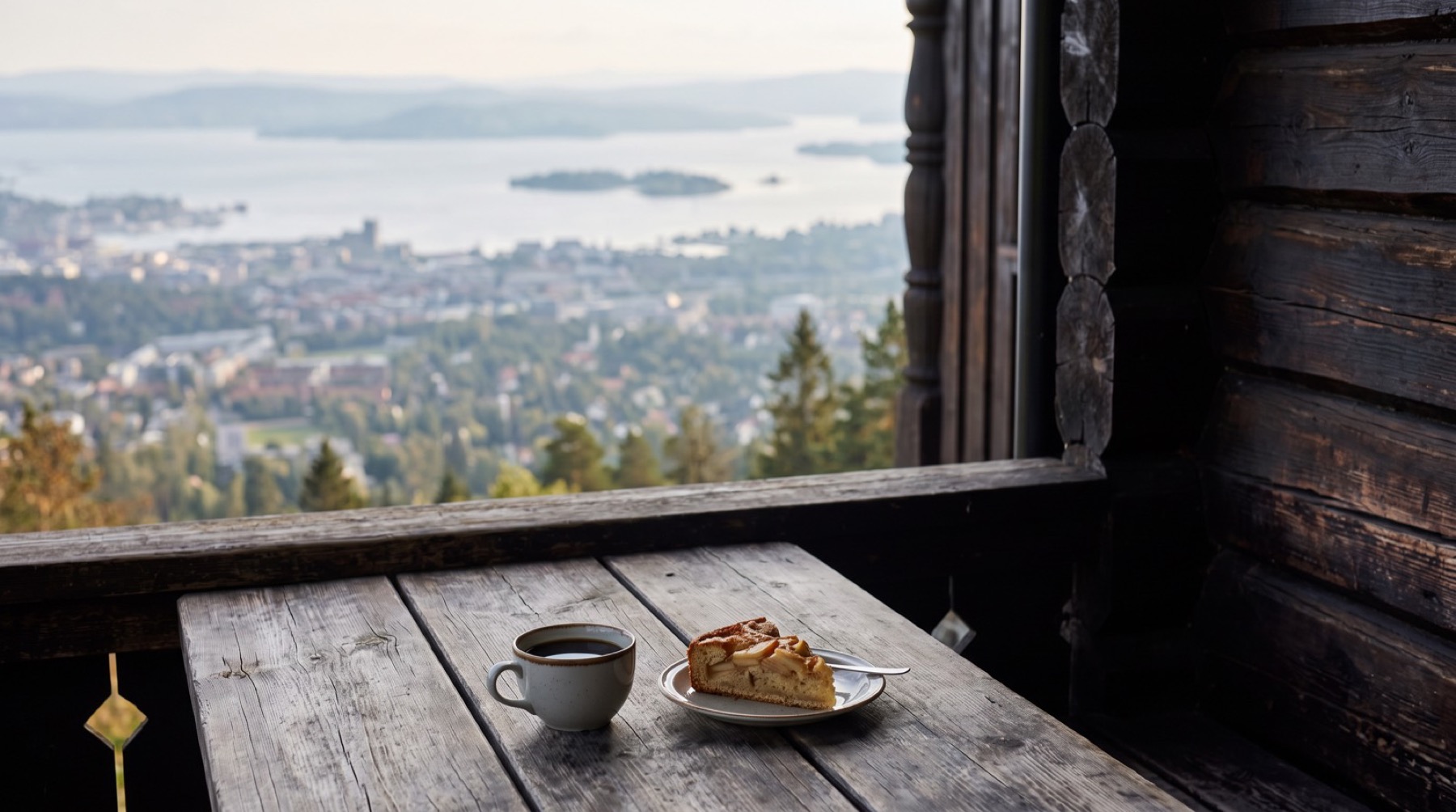
Mid-afternoon in December. The sun never climbs far, and the light stays like this for hours.
How cold is Oslo in winter?
January averages −2.3°C at the Blindern station, and January and February usually run colder than November and December. The realistic range across a winter week is −10°C to +5°C, and within that band you can get brilliant sun, heavy snowfall, drizzle, fog and freezing rain. The cold itself is dry and still, which makes it easier to handle than the damp chill of London or Amsterdam.
What catches people out is the ground. Pavements collect ice and slush, and after a freeze-thaw cycle overnight, snow compacts into sheet ice that is far worse to walk on than fresh snow. Locals wear brodder, small spikes that strap over your shoe soles; they are the one item no visitor packs and every visitor ends up wanting. Buy a pair when you land. Beyond that, the packing list is wool or fleece layers under a windproof coat, a hat and gloves, waterproof insulated boots, sunglasses for snow-bright days, and a power bank, because the cold drains phone batteries faster than you expect.
Skiing and sledding at the end of metro line 1
The list of things to do in Oslo in winter is largely a list of things sitting along one metro line. Line 1 climbs from the city centre to Frognerseteren in just over half an hour, and on a snowy Saturday the carriages fill with skis and sleds.
Cross-country. Oslomarka, the forest around the city, holds more than 2,600 kilometres of groomed cross-country trails, 90 of them floodlit. The fastest way in is the metro to Sognsvann or Frognerseteren; the trails start at the station. The terrain is hilly and not ideal for a first attempt, but Nordmarka Sports Centre grooms easy trails for beginners, and Oslo Ski Center, Bull Superski and Skimore all rent gear. Skiforeningen, the Norwegian ski association, publishes a daily report on trail conditions before you commit to the trip up.
Sledding. Korketrekkeren, "the corkscrew", is a 2,000-metre toboggan run dropping 255 metres from Frognerseteren down to Midtstuen metro station. One run takes 8 to 10 minutes; then you ride the metro 16 minutes back up and go again. The run is free and open 09:00–21:00 in winter, sleds rent for 100–150 kroner a day near the top, and there is one catch: it is a natural run with no snowmaking, so it only opens once enough snow has fallen.
Alpine. Skimore Oslo at Tryvann, which plenty of locals still call Oslo Vinterpark, is a 20-minute ride on the same line. Tryvannshøgda tops out at 529 metres, and that altitude plus snow cannons is enough to hold a season from roughly December to April. The slopes are floodlit, so people ski there after work on weekday evenings; current lift hours are on Skimore's site.
Skating, saunas and a swim at 3°C
The open-air rink at Spikersuppa sits on Karl Johans gate between the Parliament and the National Theatre, free to use and open daily from roughly late November to March. Skate rental is 200 kroner, and the ice is prepared between 09:00 and 10:00 every morning, so come after ten. Hockey sticks are banned. Wobbling beginners are welcome.
For the harder version of getting cold, KOK runs floating saunas at Langkaia, by the Opera House, and at Aker Brygge; SALT keeps its sauna village at Langkaia; and Oslo Badstuforening runs seven locations, among them Sukkerbiten, Sagene Folkebad and Hvervenbukta. With the fjord at 2–6°C from December to March, the dip between sauna rounds is a proper ice bath. Sørenga has no sauna at all; its open seawater pool is where the ice bathers who want the cold without the heat go. Book drop-in sessions ahead in all cases. Our floating sauna guide covers the full field.
Museums, and one warning
MUNCH in Bjørvika keeps late hours: 10:00–21:00 Wednesday to Saturday, 10:00–18:00 the rest of the week, with adult tickets at 280 kroner dropping to 200 after 18:00 (munch.no). The Ski Museum at Holmenkollen runs winter hours of 10:00–16:00 from October through April, an hour longer from May to September, and the 200-kroner adult ticket includes the lift up the jump tower, which on a clear day gives you the city, the forest and the fjord in a single view.
The warning: the Viking Ship Museum on Bygdøy is closed for rebuilding and reopens as the Museum of the Viking Age, planned for 2027. Do not let an older guidebook send you there.
Oslo in December: the market and the days the city closes
Jul i Vinterland, Oslo's main Christmas market, runs in Spikersuppa from 7 November 2026 to 3 January 2027, closed on the 24th, sharing the square with the skating rink: wooden stalls selling handicrafts, food and hot drinks, plus a large Ferris wheel. Entry is free, and it stays open to 20:00 or 21:00 depending on the day. Gløgg, the warm spiced drink served with almonds and raisins, is everywhere in December, and on the 13th, Lucia, you may catch children dressed in white carrying candles and handing out saffron buns.
Norwegian Christmas happens on the evening of the 24th: the festive dinner (in the Oslo region, usually ribbe, roasted pork belly) and the presents both belong to Christmas Eve. That is why the city's rhythm around those dates surprises visitors. Here is the timetable almost no guide prints:
- 24 December: supermarkets close at 15:00 or 16:00, and the Christmas market shuts for the day. After that, the centre goes quiet.
- 25–26 December and 1 January: shops, most restaurants, banks and Vinmonopolet (the state wine and spirits shop) are closed.
- 27 and 30 December: normal opening hours.
- 31 December: shops close around 16:00, Vinmonopolet by 15:00 at the latest.
- Restaurants on the 24th, 25th and 31st: closed or heavily booked. Call ahead.
Parks, the forest, the slopes and the trails stay open through all of it. Land on 24 December expecting a lively city and you will find a locked one. Land with skis or a sled in mind and you have the place to yourselves.
When it is dark by four
From late November the useful evening starts around 16:00, and the city treats it as the main event rather than a problem to wait out.
Nordic Pixel Forest in Ekebergparken is the clearest example. Pipilotti Rist's permanent installation hangs 3,600 eight-fold LED points from 400 steel cables seven metres above the forest floor, across 212 square metres, and the colours and patterns shift with the weather and with the movement of the people walking underneath. The sculpture park is free and always open, and the work only really exists after dark, which in December means from mid-afternoon. The floodlit ski trails in the forest run on the same logic: the skiing happens at night, under lights, and that is the point.
One expectation needs managing: the northern lights. Oslo sits too far south to count on them, and nobody should plan a December trip here around aurora. We have written about the realistic odds in our northern lights guide.
A bonfire in Nordmarka
Our land side, See Oslo, runs chauffeured private days up into Nordmarka, and from November to March those days take their winter form. The car still climbs to Frognerseteren. At the lake there is a bonfire instead of the summer camp, and the afternoon can include a cross-country skiing lesson in the tracks above the city, or snowshoes if the group prefers to walk. In December it is dark by four, so the day starts earlier and ends at the fire. Winter days are planned individually around each group. Write to us with your dates.
The fjord in winter
The inner fjord almost never freezes any more. In the week between Christmas and New Year, when the city is half closed, the water out there is the quietest it gets all year.
Our own boat comes out of the water in October and goes back in for the spring, so from November to March the fjord is something you meet from the edge of it: the blue hour off the Sørenga pier, a ladder into 3°C water beside a sauna, the island boats on their winter timetable. Our guide to the Oslofjord in winter covers all of it, including where to stand for the blue hour and which operator sits on which quay.
One last practical note, because it is the one that ruins the most Decembers: if you arrive on the 24th, buy your groceries before three.
Opening hours, ticket prices and season dates above are as of July 2026 and change from year to year. Check each operator's own site before you go.
More from the fjord
Oslo in Summer: What the Locals Actually Do
Island ferries for 42 kroner, 23°C swimming coves, floating saunas and 18-hour days: how Oslo actually spends its summer, month by month.
GuideRain on the Oslofjord: Will the Cruise Still Run?
Rain alone does not stop an Oslofjord cruise. Wind, swell, and lightning do. The weather criteria, when we reschedule, and how the boat handles a wet day.
GuideNorthern Lights on the Oslofjord: An Honest Guide
The Oslofjord sits at 60°N, far south of the auroral zone. You can see the lights from the fjord — once or twice a winter, on KP6+ nights. What that actually means.