The harbour porpoise (Phocoena phocoena, nise in Norwegian) is the cetacean you actually meet in the inner Oslofjord. Adults run 1.4 to 1.9 metres and average 50 to 60 kilos. Havforskningsinstituttet says the species occurs regularly in the fjord and that its movements here are not well mapped; nobody has counted the animals in the inner fjord. The places worth watching are the deep water east of Nesoddtangen, the channels around Steilene, and the Drøbak narrows, on calm mornings and evenings.
Oslo has container ports, commuter ferries, cruise ships. The Oslofjord is also a functioning marine ecosystem. Spend enough time on the water in the quieter channels between the islands and you will see one. The trick is knowing what to look for and what you are actually looking at.
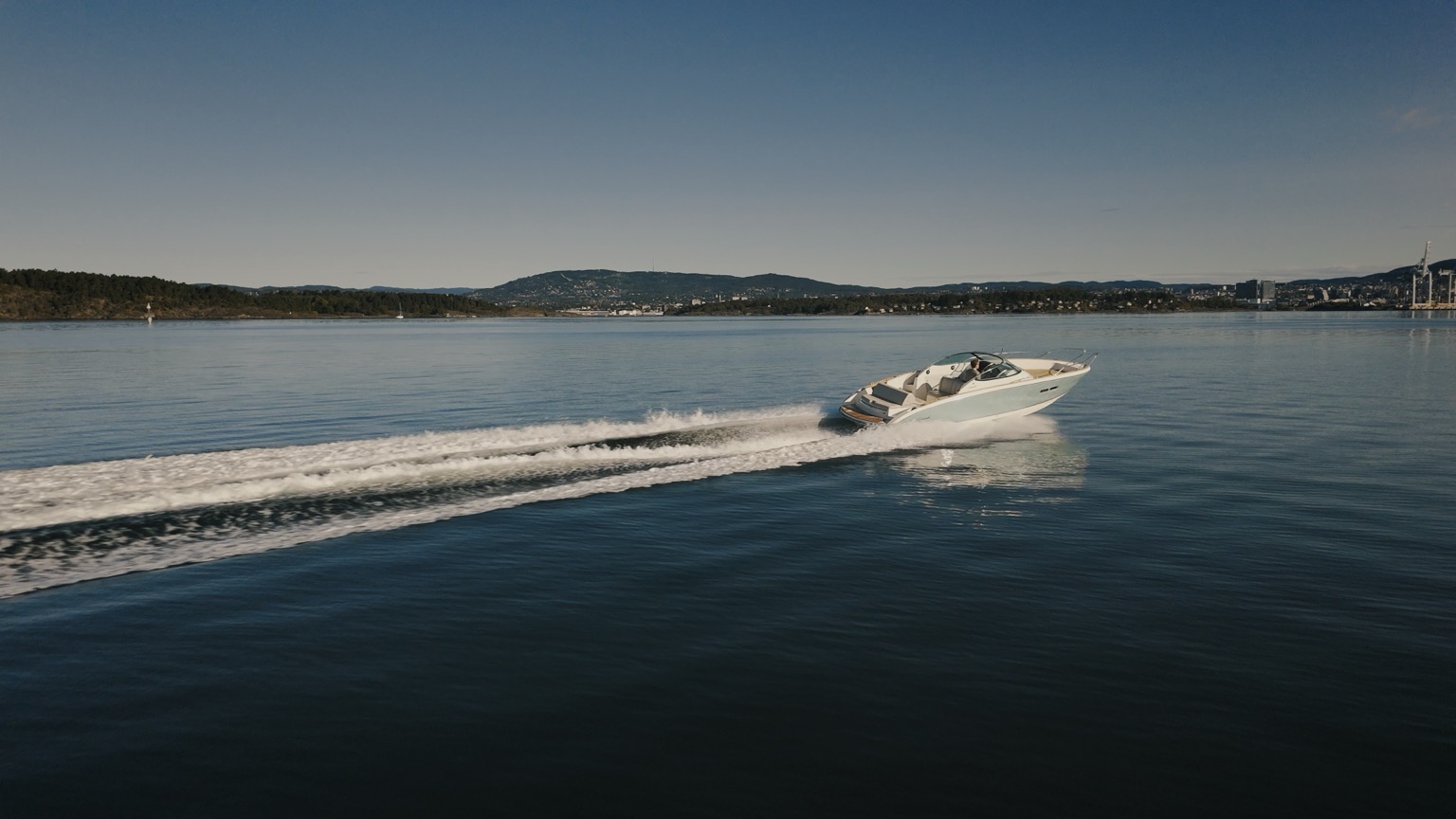
The inner Oslofjord, where porpoises hunt herring in a working shipping lane
The harbour porpoise: the whale you don't notice
The harbour porpoise (Phocoena phocoena) is the only cetacean you're likely to encounter in the inner Oslofjord, and it is a small, compact animal. Havforskningsinstituttet gives the average female as 160 centimetres and 60 kilos, the male as 150 and 50; NOAA puts its regional adult range at 1.5 to 1.7 metres. That is roughly the size of a large dog. Next to a bottlenose dolphin, which can reach 4 metres, a harbour porpoise looks modest. Few of them get old: the maximum recorded lifespan is about 24 years, and only some five per cent of animals live past twelve.
Their colouring is understated: dark grey back fading to lighter grey on the flanks, pale belly. The dorsal fin is small and triangular, a stubby low-profile shape that sits mid-back. This is the most useful identification feature. A dolphin's dorsal fin is tall and curved, almost theatrical. A porpoise's fin is blunt and low.
Behaviourally, harbour porpoises are the opposite of dolphins: shy, solitary or in pairs. They surface briefly, a quick roll forward to breathe, then back under. They don't breach or bow-ride alongside boats. If you've seen a nature documentary with dolphins leaping in synchrony beside a ship, forget that image. A harbour porpoise encounter is quieter, faster, and much easier to miss. I've been on the fjord hundreds of times and I still get a little rush when one appears, because you never quite expect it even when you're looking.
The menu is long and shifts with the region: capelin in the far north, herring and sprat along the Skagerrak coast, a good deal of bottom fish over in the Kattegat. They hunt alone and by ear rather than eye, with echolocation clicks at around 130 kHz, among the highest frequencies of any cetacean and well above anything we can hear.
Counting a species that shows itself for less than a second at a time is hard. The SCANS-III survey covered 1.8 million square kilometres of European water in the summer of 2016, from Gibraltar to northern Norway, and came out at roughly 467,000 harbour porpoises. Closer to home, Havforskningsinstituttet works with an estimate of about 14,000 from the Oslofjord and southward through Skagerrak. For the inner fjord there is no figure at all: the institute says the porpoise turns up here regularly and that its movements have not been mapped. Since 2023 it has kept six listening buoys in the water further down the coast, logging porpoise clicks to work out relative numbers through the year.
Where to see them from a boat: the deeper channels between the islands, particularly around the outer islands and the Drøbak (DROO-bahk) narrows, the tightest point in the whole Oslofjord. Early morning and late afternoon are best. The water is calmer, boat traffic lighter, and the porpoises seem to feed closer to the surface.
What is the difference between a dolphin and a porpoise?
We get this question constantly, and the confusion makes sense. Dolphins and porpoises are both small cetaceans, both toothed whales, and to a casual observer they can look similar. But they belong to different families and differ in ways that matter once you know what to watch for.
| Feature | Dolphins | Porpoises |
|---|---|---|
| Dorsal fin | Tall, curved | Small, triangular |
| Snout | Long, pointed (beak) | Short, blunt, rounded |
| Size | 2–4 metres | 1.4–1.9 metres |
| Teeth | Conical | Flat, spade-shaped |
| Behaviour | Social, playful, often in groups | Shy, solitary or in pairs |
| Surface style | Leaps, bow-rides, splashes | Quick roll, barely visible |
In the Oslofjord, the harbour porpoise is what you'll see. True dolphin sightings (bottlenose dolphins, Tursiops truncatus, or white-beaked dolphins, Lagenorhynchus albirostris) do occur in Norwegian waters, but they're rare and concentrated along the outer coast and open North Sea, not in the inner fjord. If someone tells you they saw "dolphins in the Oslofjord," they almost certainly saw harbour porpoises.
When and where to spot harbour porpoises
Harbour porpoises live in the Oslofjord throughout the year, but your chances of spotting one vary a lot depending on season, weather, and where on the water you are.
Best months: June through September. Prey fish (herring, sprat) move into shallower, warmer waters to feed and breed during these months. The porpoises follow. In midsummer, they can sometimes turn up surprisingly close to the inner islands, within a few kilometres of Oslo's harbour.
Best conditions: Calm water matters most. A harbour porpoise surfaces for barely a second, and its dorsal fin sits only a few centimetres above the waterline. Any chop at all and you won't see it. Flat water on a windless morning or evening is what you want. Overcast days actually help because there's less glare bouncing off the surface.
Best times of day: Early morning (before 08:00) and late afternoon (after 17:00). Less boat traffic, calmer water, and porpoises tend to feed nearer the surface during these quieter hours.
Best locations from a boat: The deep water east of Nesoddtangen (NEH-sod-tang-en) is consistently productive; the trench off Svartskog drops to 154 metres. The waters around Steilene (STAY-leh-neh), the cluster of outer islands south of Gressholmen (GRESS-hol-men), are good too, and that is where the harbour seals haul out on the rocks. The Drøbak narrows are the third place. The tightest point in the fjord is also the shallowest: a sill carrying 19 metres of water, which is why everything behind it renews so slowly, and the current pouring over it packs herring and sprat into a small space. Oscarsborg sank the German cruiser Blücher at that sill on 9 April 1940, and the wreck has since slid down to 90 metres just inside it. If I had to pick one route for porpoise spotting, I'd head south toward Steilene on a calm July morning, the kind of run you can do on a full-day tour when there's no rush to turn back.
From shore: Possible but tough. Porpoises occasionally get spotted from the Bygdøy (BIG-doy) beaches or by passengers on the Nesodden ferry. Binoculars help. Look for a small, dark shape that appears and disappears in a forward-rolling motion. You will see no splashing and no jumping, maybe a brief puff of breath mist that hangs for a moment in cool air.
What to look for: Forget the dolphin imagery: there is no leaping or tail-slapping. A harbour porpoise sighting is a small triangular fin breaking the surface, rolling forward, and sinking back, one to two seconds in total. If you're close enough and the air is still, you may hear a faint, soft exhalation. Scanning a wide stretch of calm water works better than staring through binoculars.
Other wildlife you may encounter
The harbour porpoise isn't the only wild animal out here. The fjord supports a surprising range of marine and coastal wildlife, most of it visible to anyone who bothers to look.
Harbour seals (Phoca vitulina) are the easiest large mammals to find. We see them regularly on the outer islands around Steilene, hauled out on exposed rocks to rest and warm up. From a respectful distance you can see them clearly: grey-brown lumps on the rocks that occasionally lift a head to watch you pass. We usually cut the engine and drift on our tours when we're near them so we don't spook anyone. Grey seals (Halichoerus grypus) are rarer but show up in the outer fjord, particularly in winter.
White-tailed eagles (Haliaeetus albicilla) have made a comeback in the Oslofjord region. They're not common around the inner islands yet, but sightings near the outer fjord have increased over recent years. With a wingspan of up to 2.4 metres (nearly 8 feet), they are unmistakable.
The birdlife is rich even without eagles. Common eiders bob in rafts near the islands. Cormorants stand on rocks with their wings spread to dry (they look ridiculous, like they're trying to air out a coat). Great black-backed gulls, the largest gull species in the world, patrol the channels. In summer, Arctic terns dive for small fish around the shallows, and oystercatchers pipe from the rocky shores.
Beneath the surface, the Oslofjord holds cod, mackerel (in summer and autumn), sea trout, and several species of wrasse and goby. You won't see them from the boat, but they are why the porpoises and seals are here, and why the eagles are returning.
Why are there harbour porpoises in an urban fjord?
The Oslofjord receives runoff from a metro area of over one million people, container ships pass through its narrows, and ferries cross it every half hour. That is not obvious porpoise habitat.
But the inner Oslofjord today is a very different body of water from what it was in the 1970s. For most of the twentieth century, untreated or barely treated sewage flowed straight into the fjord. Oxygen levels at the bottom dropped so low that large areas became dead zones. There were no fish, no crustaceans, nothing alive below a certain depth. The water near Oslo smelled, swimming was discouraged, and marine mammals were scarce. My grandfather's generation remembers the fjord as basically an open sewer.
The turning point came with sustained investment in wastewater treatment. Oslo and the surrounding municipalities built modern sewage plants that removed nutrients before discharge. The Norwegian Institute for Water Research (NIVA) has monitored the fjord's recovery over decades. Oxygen levels at the bottom have improved, though they remain fragile. Nutrient concentrations have dropped. Seagrass beds, critical nursery habitat for young fish, have begun to recover in some areas.
As water quality improved, fish came back. Cod, which had been basically absent from the inner fjord, reappeared. Herring and sprat populations stabilised. And the porpoises, which go wherever the fish go, followed. Clean water grows seagrass, seagrass shelters small fish, small fish attract bigger fish, and bigger fish attract porpoises.
The recovery isn't complete. The Oslofjord still faces pressure from agricultural runoff, warming temperatures, and periods of low oxygen at depth. The Norwegian government's Biodiversity Information Centre lists the harbour porpoise as "least concern" nationally, but local populations in enclosed waters are more vulnerable than open-ocean ones. What we have here now isn't guaranteed to last. It depends on continued investment in water quality and responsible management of the fjord's resources.
Porpoise or dolphin? How to tell
You get one or two seconds of animal, so know what to look for in advance.
Size. A harbour porpoise is small: most adults are around a metre and a half, and even a big one stays under two metres. Dolphins run considerably larger, from two metres up to four.
The head. A porpoise has a blunt, rounded head with no beak at all. Dolphins carry the long, pointed snout everyone knows from photographs. If you can see a beak, it is not a porpoise.
The fin. The porpoise's dorsal fin is low and triangular, barely clearing the water. A dolphin's fin is tall and sickle-shaped, curving backward.
The behaviour. This is the giveaway at distance. A porpoise surfaces in a short, calm forward roll, fin up and fin down inside a second or two, and it does not jump. Dolphins leap, splash, and ride bow waves, often in groups.
In the inner Oslofjord, the odds settle most sightings for you: the harbour porpoise is the one that is here all year, and true dolphins are rare visitors concentrated along the outer coast. A small dark fin rolling through calm water off Nesodden or Steilene is a nise.
A working fjord
The Oslofjord is a shipping lane, a commuter ferry route, and the recreational backyard of a capital city. Tankers pass through the Drøbak narrows on their way to the oil terminal. The ferry to Denmark leaves every evening. Sailboats jostle for anchorage on summer weekends.
The same water holds the wildlife. Porpoises hunt in the deeper channels between the islands, harbour seals haul out on Steilene, and the water that people swim in on summer afternoons supports a food chain running from plankton to porpoises.
A million people live around this water, and a functioning marine ecosystem uses the same narrow basin. The fjord is far from pristine, and the porpoises are in it anyway.
The porpoise is a species that has inhabited these waters since long before Oslo was a city, and it stays because the essentials hold: fish, deep water, and enough quiet between the ferries to hunt. If you want to see one yourself, pick a calm morning, head south past the inner islands, and watch the water. Patience helps more than binoculars.
Population figures here come from Havforskningsinstituttet and the SCANS-III survey and shift with every new count. Last reviewed July 2026.
A small dorsal fin breaks the surface 30 metres off the bow, then nothing for a minute and a half, then the same fin twice as far out. They are working a line of herring, and on a flat morning you can follow that line across the water without touching the throttle.
More from the fjord
Whale Watching in Oslo: What Actually Swims in the Oslofjord
No whale safaris run from Oslo. What the fjord actually holds: harbour porpoises year-round, seals on the skerries, and the documented whale visits of 2003–2025.
GuideSeabird colonies of the Oslofjord: which skerries, which birds, when to stay away
The inner Oslofjord has 14 seabird reserves with a strict access ban 15 April – 15 July. Which islands matter, and which birds nest there.
GuideSeals in the Oslofjord: where they really are
The big haul-outs are at Hvaler, Færder and Bolærne, not in the inner fjord. What the counts show, why a skerry at Steilene is named Selskjær, and your honest odds of seeing one.