
Oslo sits at 59.9°N, and the evenings here run long because of it. In mid-June the sun does not go down until 22:44, and the sky still holds usable light at 00:22. By mid-September the whole thing is finished by 20:21. Sunset cruises board two hours before sundown and run four hours, which puts you on the water for the entire slide from full daylight into blue hour.
I have watched something like three hundred sunsets from the boat and it still stops the conversation. By nine on a July evening the sun is low over the western tree line and the fjord goes copper, a full hour and a half before it actually sets. The water flattens out. Gressholmen, Heggholmen and Nakholmen, islands that looked perfectly ordinary all afternoon, start glowing at their edges. The air cools just enough that someone on board reaches for a jacket. And then everything gets very, very pretty.
If you have browsed the five-star reviews or scanned our frequently asked questions, you already know: guests mention the sunset more than any other part of the trip, more than the swimming, the route, or us. We take that as a compliment, honestly. The fjord at that hour does most of the work.
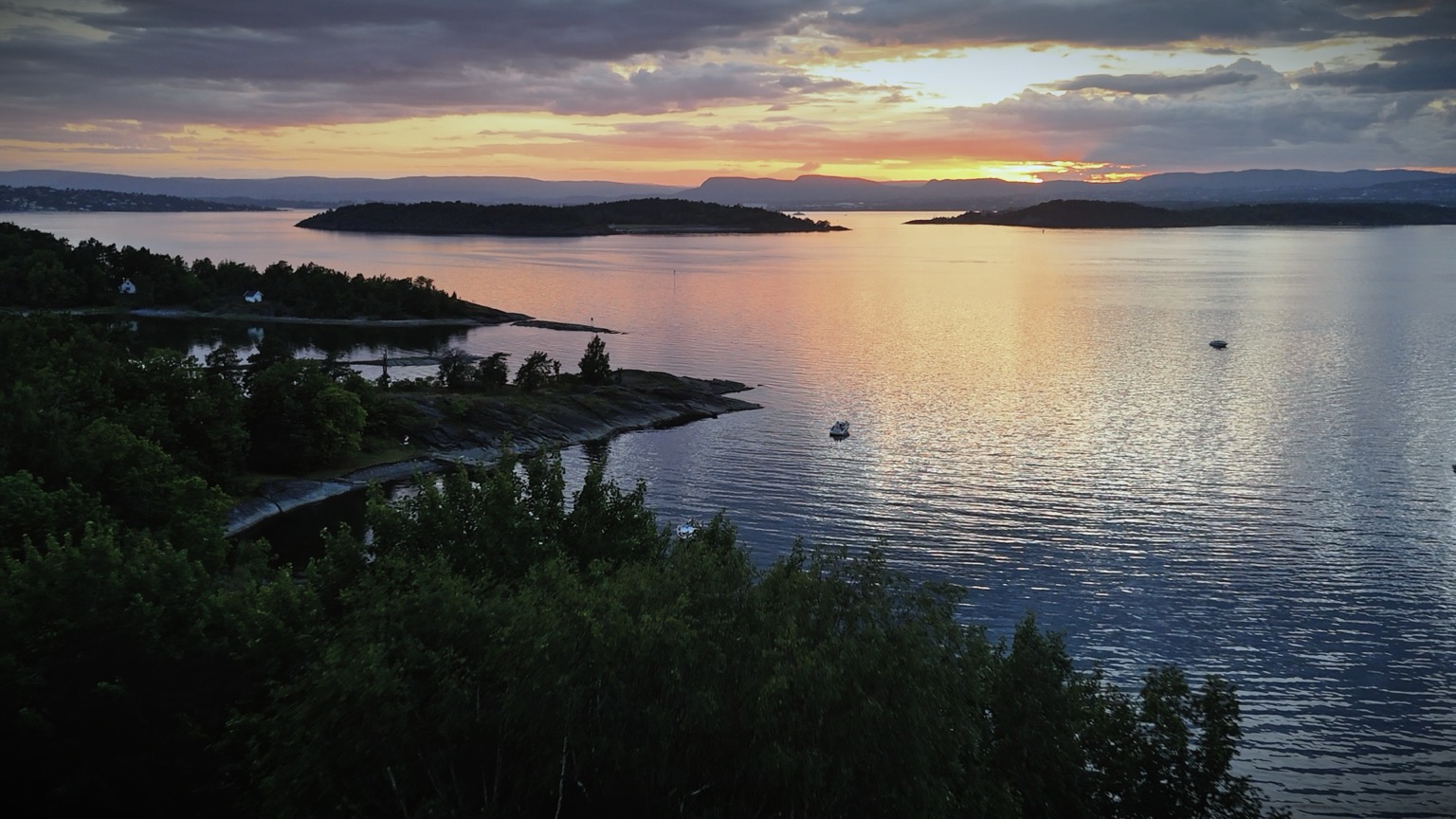
The view south from the inner islands as the sun drops below the horizon
What the light actually does
If you have only seen the Oslofjord during the day, you have seen a different place. Daytime fjord is blue-green, busy, full of ferries and sailboats. It looks like a harbour. Evening fjord is a mirror. The surface goes glassy and the line between water and sky gets hard to find.
The city changes too. Oslo's skyline is mostly glass and steel, modern buildings designed by people who understood what Scandinavian light does at low angles. At sunset every window catches fire. The Barcode district, which during the day looks like a row of oversized book spines, turns into a wall of gold. The Opera House roof goes from white to amber to pink. From the water you see it all at once, the whole panorama, and that angle is not available from shore.
The reason is latitude. Wikipedia puts the city at 59°54′48″N, and at that angle the sun takes a long time over its last few degrees. The colour deepens so gradually that you only notice how much has changed when you look back at the wake and realise the water is not blue anymore. We sometimes point it out, but most people catch it on their own. Someone will say "wait, when did it turn orange?" and everyone looks down at the same time.
When does the sun set in Oslo?
Timing shifts a lot across the season. A June sunset cruise and a September one are different evenings, both good. The times below are mid-month values for 2026, calculated for Oslo by sunrise-sunset.org. Last light is the end of civil twilight, the point where the sky stops giving you enough to see by.
| Date | Sunset | Last Light |
|---|---|---|
| 15 June | 22:44 | 00:22 |
| 15 July | 22:27 | 23:41 |
| 15 August | 21:13 | 22:02 |
| 15 September | 19:41 | 20:21 |
Once the sun has gone in mid-June you still have ninety-eight minutes of light. By mid-September you have forty. And in June and July the sun never gets twelve degrees below the horizon at all, which is the point where the sea horizon stops being visible, so Oslo does not get a properly dark night in high summer. Nothing about the evening is hurried. The light deepens slowly enough that you stop watching the sun and start watching the water, which picks up each new shade and holds it. People talk less as it goes, and nobody seems to mind.
The spot: where your captain anchors
There is no fixed itinerary. We choose the anchorage based on wind, weather, and where the other boats are. On a calm summer evening it might be a bay between Gressholmen and Heggholmen, with a clear sightline to the western horizon. On a windier night it could be a sheltered cove behind Hovedøya (HOO-ved-oy-ah), where the water is flat and the pine trees frame the sky. Either way the idea is the same: engine off, boat rocking gently, facing the right direction.
I have a favourite spot between the two smaller islands where there is a gap in the tree line that frames the sunset almost too perfectly. It looks like someone planned it. On a good night in late June the sun drops right into that gap and the whole surface in front of you turns gold. The seagulls always congregate on one specific rock nearby around that time. I have no idea why that rock.
If you want to know what the rest of the trip looks like before and after this moment (the departure from Tjuvholmen, the route through the islands, the swimming) our piece on what actually happens on a three-hour fjord cruise walks through it in detail.
"We settled for some wine over the calm water, watched the sunset and headed back. Overall a 10/10 experience."
William's review lists three things, two of them calm water and sunset. Most of them read like that. Nobody writes a paragraph about it afterwards.
Swimming into the light
On warmer evenings (mid-June through early August, when the fjord surface typically sits around 18-20°C; check the live sea temperature before you go) there is an option that surprises people: jumping in. The water at sunset is different from the water at three in the afternoon, calmer and warmer at the surface. The low light turns the spray around your hands to gold. Some guests say it is the best part of the whole trip, and honestly, they might be right.
We have written separately about swimming in the Oslofjord if you want the full picture on water temperatures and what to expect. But if you are choosing between a daytime swim and a sunset swim, the sunset swim wins, and it is not a close call.
The return: Oslo at night from the water
After the sun drops behind the tree line the sky keeps working for a while: forty-nine minutes of usable light in mid-August, forty in mid-September. Norwegians call it blåtimen, the blue hour, and the word carries a weight beyond the weather: this stretch between day and night when the world feels paused. On the water, surrounded by it, you get why.
This is when we weigh anchor and head back. The return trip is slower than the outbound leg. City lights are coming on. Akershus Fortress is lit from below by the LED scheme Forsvarsbygg installed to pick the walls and towers out of the dark, medieval stone glowing yellow against the sky. The harbour is quieter now, with fewer ferries and fewer kayakers and the occasional sailboat heading home.
"A swim at open sea, and arriving back at the docks with the sunset. What is not to love!"
Arriving at a city from the water at dusk does something to your sense of scale. Buildings that towered over you at street level sit low against the horizon, their reflections stretching across the harbour toward you. You left Oslo three hours ago and you are coming back to a place that looks different.
Why everyone says the same thing
Across platforms, languages and years, reviewers keep landing on the same moment: the calm water, the light. Most visitors see Oslo from street level, walking Karl Johan, visiting Vigeland Park, eating at Aker Brygge. The city is fine from shore, but it was a working port long before it was a capital, and the fjord at sunset is the angle it was built for.
Being on a small boat while it happens changes the register. The boat takes seven guests, there is no loudspeaker and no script, and by sunset you have been talking with your captain for two hours, so the formality of "tourist experience" has worn off.
Then there is the latitude. At 59.9°N the sun comes down at such a shallow angle that the light thins and warms and spreads until the whole fjord is holding it. It does not photograph well, which is the standard complaint at the end of every evening departure. We have stopped trying to describe it in the booking info and just write "evening departure".
By nine on a July evening the fjord goes copper, and the sun still has an hour and a half to go before it sets. The water flattens to glass, the islands start glowing at their edges, and somebody always reaches for a jacket. In mid-June there is still light in the sky at half past midnight. By mid-September we are back at the dock in the dark.
Sunset and last-light times are mid-month values for Oslo (59.9°N) in 2026, calculated with the US Naval Observatory algorithm via sunrise-sunset.org. For your own travel dates, check timeanddate.com's Oslo sun calendar. Times verified 30 July 2026.
More from the fjord
Winter on the Oslofjord: What the Cold Season Looks Like from the Shore
The boats come out of the water in October, and the fjord stays open. Floating saunas, ice swimming, Christmas in Drøbak, and a coastline that looks completely different under low Nordic light.
GuideOslo in Summer: What the Locals Actually Do
Island ferries for 42 kroner, 23°C swimming coves, floating saunas and 18-hour days: how Oslo actually spends its summer, month by month.
GuideOslo in Winter: What's Open, What's Worth It, and How Dark It Really Gets
Around six hours of daylight, sledding from the metro, free skating at Spikersuppa and the exact days Oslo closes for Christmas. November to March, honestly.
See for yourself
Private Cormate T28 charter on the Oslo Fjord.
Up to seven guests. Fixed pricing. Departures from Tjuvholmen, Oslo.
Check pricing & availability