
A three-hour Oslo Fjord cruise on the Cormate T28 leaves from Tjuvholmen, runs east past the Opera House and Akershus Fortress, then turns south through the inner fjord to Hovedøya, Gressholmen and the cabin islands at Bleikøya and Lindøya. The captain picks the anchorage on the day, based on the wind. The boat takes seven guests and never anyone from outside your group.
Guests ask what actually happens out there, and the honest answer is that it depends on the day, the wind, who is aboard, and whether the eider ducks have camped out near Gressholmen again. Here is roughly how three hours go. If you have questions about the Oslofjord before booking, that page covers the basics. This one covers what it feels like.
Leaving Tjuvholmen
We meet at Tjuvholmen, five minutes on foot from Aker Brygge and about the same from the National Museum. You get a map pin after you book, so nobody spends twenty minutes walking the wrong pier. The boat is prepped when you arrive. The Cormate T28 is a Norwegian-built daycruiser: 28 feet, clean Scandinavian lines, a 350-horsepower Mercruiser under the rear hatch, seats for seven. There is no second deck, no PA system and nothing to queue for. Just a boat, your group, and one of us driving it.
The safety briefing takes two minutes. Life jackets, swim ladder, what to hold when the throttle opens. Then we cast off, and the first thing everyone notices is how the city reorganises itself from the water. Buildings you have walked past for days suddenly have context. You can see how the harbourfront connects to the fortress, where the shoreline bends. It is the difference between reading a map and seeing the terrain.
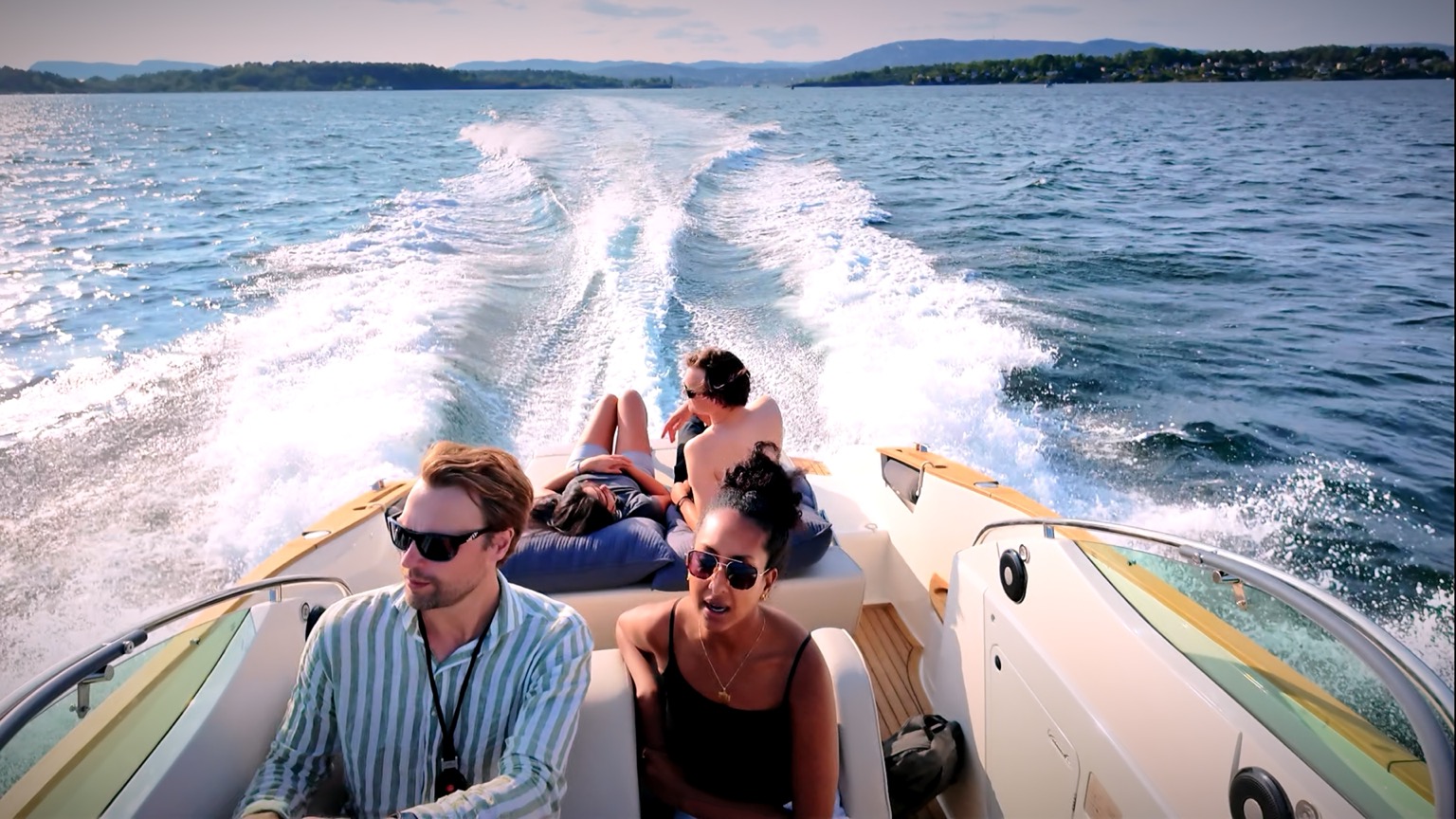
Guests cruising between the islands on a July afternoon
The city from the water
The boat turns east along the harbour and the Oslo Opera House appears first. From shore it looks like an angular white wedge. From the waterline it looks like a glacier calving into the fjord, marble and granite meeting the surface at a shallow angle, the roof merging with the sky. Behind it the Munch Museum rises in dark glass. Then the medieval walls of Akershus Fortress. Håkon V started building it somewhere between 1299 and 1304, and by 1308 it was solid enough to turn back Duke Erik of Sweden. It still looks like it means it.
None of us read from a card. I grew up here, Adrian grew up here, Are grew up here. We know which building along Bjørvika used to be a shipyard, which warehouse stored salt cod for export, where the old ferry terminal stood before the city rebuilt its waterfront in the 2000s. Ask a question and you get a real answer with a date attached instead of a rehearsed line. Guests bring this up in reviews more than anything else. Most people can tell the difference between someone who learned the script last week and someone who has been on this water since they were a kid.
Past the container port, the working side of Oslo that most visitors never see, you pick up the Dyna lighthouse on its skerry at the entrance to the inner harbour. The cast-iron tower, keeper's house and bell tower went up in 1874, so it has marked the channel between the city and the islands for over 150 years. It is automated now, but the silhouette is the one steamship captains navigated by: red base, white lantern room. We always slow down here. Most boats do not.
"Simon took us for a tour of Oslo's waterfront and had great information about the city and history of the area. After, we boated around the islands and coastline to see some of his favorite places. A unique perspective of the area that's less touristy and very beautiful!"
Somewhere along this stretch the throttle opens. The T28 was not built for crawling. On calm water it planes quickly and moves with a sharpness that catches people off guard. Wind in your face, spray off the bow, and almost everyone starts grinning, including the ones who booked this as a relaxing sightseeing tour. It lasts a few minutes, long enough to feel all 350 horses, and then we ease back as the islands come into view.
The islands appear
The inner islands sit close enough to the harbour that you can pick out individual trees from the quayside: Hovedøya, Gressholmen, Bleikøya, Lindøya, Nakholmen. From a boat moving between them, the scale becomes real. Hovedøya has old military earthworks and the ruins of a Cistercian monastery founded in 1147. Gressholmen is a nature reserve with an aircraft hangar still standing on it, used as boat storage now. It belonged to Oslo's first airport, a seaplane harbour, and the sources disagree about its run: Store norske leksikon gives 1926 to 1938, while Norwegian Wikipedia dates the opening to 1927 and has the seaplanes moving to Fornebu as late as 1952. The same island was known for its wild rabbits until they were culled at Easter 2007, when the grazing was found to be eroding the ground and stripping out protected plants. Bleikøya and Lindøya are cabin islands: no cars, no shops, summer houses and footpaths through the pines.
If you want to come back on your own, the public ferries reach the inner islands on an ordinary Ruter ticket, 46 kroner for a single in zone 1 as of July 2026 (current fares here, and Ruter adjusts them every January). Our island guide has departure times and what to find on Hovedøya.
We pick the anchorage based on the day. Wind direction, swell, how many other boats are out, whether the tide has exposed the flat rocks on the south side of Gressholmen or made the cove at Nakholmen swimmable. There is no fixed route. The islands stay the same and the conditions shift constantly, and after running this water every week for years you learn to read it fast.
The engine goes off. The boat rocks gently on its anchor line.
And then, quiet. Not silence. There are gulls, water lapping the hull, maybe a distant outboard behind Nakholmen. But the city noise is gone, all of it. Ten minutes from a capital city and you can hear your own breathing. It hits most people harder than they expect, as though they had not registered how much background noise they had been absorbing for days. I still notice it after hundreds of trips. The moment the engine cuts and the water takes over is the best part of my job.
The swim ladder comes down. Oslo kommune publishes water quality and temperature for every bathing spot in the city, the inner fjord islands included. In July and August the water out here usually sits between 18 and 22°C (64–72°F), which is bracing on entry and comfortable after thirty seconds. Today's reading is here. Some guests dive off the side, some ease in from the ladder, some stay on deck and watch. No pressure either way. There is more on what swimming in the Oslofjord is actually like in a separate piece: water quality, how the temperature moves through the season, what it feels like to float between islands with the Oslo skyline behind you.
While you swim, or after, the food comes out. Norwegian snacks and drinks are included on every trip. If you have added the premium food and drinks package, this is where it appears, served on the aft deck while the boat drifts. Pine trees lean out over the rocks nearby. The water goes from dark blue to pale green where the seabed rises.
"The scenery was absolutely stunning and we were all able to go swimming in a cute secluded spot with a family of ducks!"
The wildlife around these islands is richer than it looks. Eider ducks nest on Gressholmen. Grey herons stand motionless in the shallows off Bleikøya. Harbour porpoises turn up in the inner fjord more often than they used to. You may not see one on any given trip, but you will see cormorants drying their wings on the navigation markers and jellyfish pulsing under the hull. Last August I watched a heron catch a fish roughly fifteen centimetres from a guest's foot while she stood on the rocks. The heron did not care at all.
Arriving from the sea
The ride back takes a different route. We might loop around the southern tip of Gressholmen, or swing wide past Nakholmen and come in from the west. The return is slower and more open. If we have a drone on board, and we usually do, this is when it goes up: aerial footage of the boat from above, the wake cutting a white line through blue water, the islands scattered behind you. That footage is yours, delivered digitally after the trip.
On evening tours when the light turns golden, the return is the part guests photograph most. The low sun catches the Opera House roof and turns it amber. Akershus Fortress goes dark against a sky that, in June, stays lit until nearly midnight. The water flattens in the evening calm and reflects the colour back. It is the kind of light that makes everyone reach for their phone at the same time.
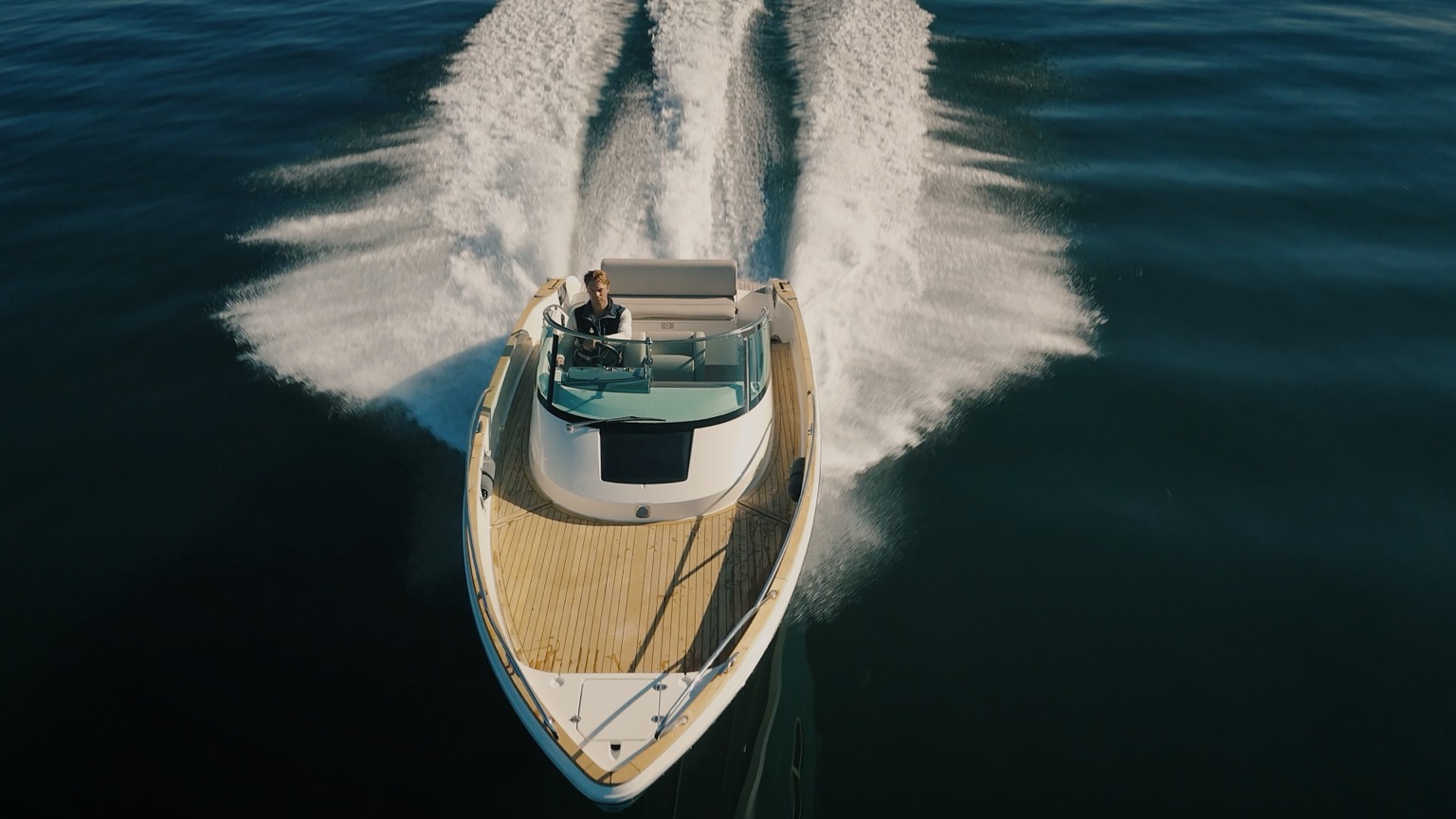
Your captain at the helm
What people do not expect
Guests almost always mention the same surprise: how personal it feels. No other passengers, no itinerary printed on a card. If you want more swimming and less sightseeing, we do that. Any of us will happily talk for three hours about the history of every building you pass, or say nothing at all and leave you with the water. Seven people maximum, and most trips are couples, families or small groups who already know each other. The dynamic is closer to being invited onto a friend's boat than boarding a tour.
The other thing people underestimate is how close the islands are. Island hopping near Oslo sounds like a marketing invention until you are doing it. Ten minutes from the harbour and you are anchored between two forested islands in water clear enough to see the bottom, with the city still visible but oddly distant, as though you left it hours ago instead of minutes.
That is roughly the shape of the three-hour private cruise. You step off at the same dock you boarded from, probably windswept, possibly sunburned if you skipped the sunscreen, and the city looks different from how it looked when you left. We hear that a lot. Seeing a place from the water for the first time rearranges it.
We don't read from a script. I grew up here, Adrian grew up here, Are grew up here. Ask which warehouse used to store salt cod and you get a real answer with a date attached. The route adjusts to wind, swell, who's on board, whether the eider have decided to camp out near Gressholmen.
The boat runs from May to September; it comes out of the water for the winter. Prices, water temperatures and Ruter fares change through the year, so the linked pages are the live ones. Last reviewed: July 2026.
More from the fjord
What guests write about: a tailored route, a local captain, a boat to themselves
Guests keep mentioning the same things: a route built around what you want, local captains, and a private boat that never feels like a tourist trip.
GuidePrivate Charter vs the Electric Sightseeing Cruise on the Oslofjord
The silent electric cruises (Brim, MS Brisen) are shared, scheduled and from ~690 kr a head. A private charter is the whole boat from 16,688. Which one fits your trip.
GuideTipping on an Oslofjord Boat Tour: A Guide for Visitors
Norway has no tipping culture in the American sense. On an Oslofjord cruise, NOK 200–500 is generous; a written review is more useful. What captains actually want.
See for yourself
Private Cormate T28 charter on the Oslo Fjord.
Up to seven guests. Fixed pricing. Departures from Tjuvholmen, Oslo.
Check pricing & availability