
79 reviews sit across TripAdvisor, Google and GetYourGuide. 68 of them are in our own register with the text intact, once the rating-only ones and the cross-posts are stripped out. All three of us read every one, usually in the group chat within an hour of it appearing, and we read them for the detail rather than the score.
So we read the whole set end to end, as one long document, to see what guests bring up when nobody asks them a question. Three things surface again and again.
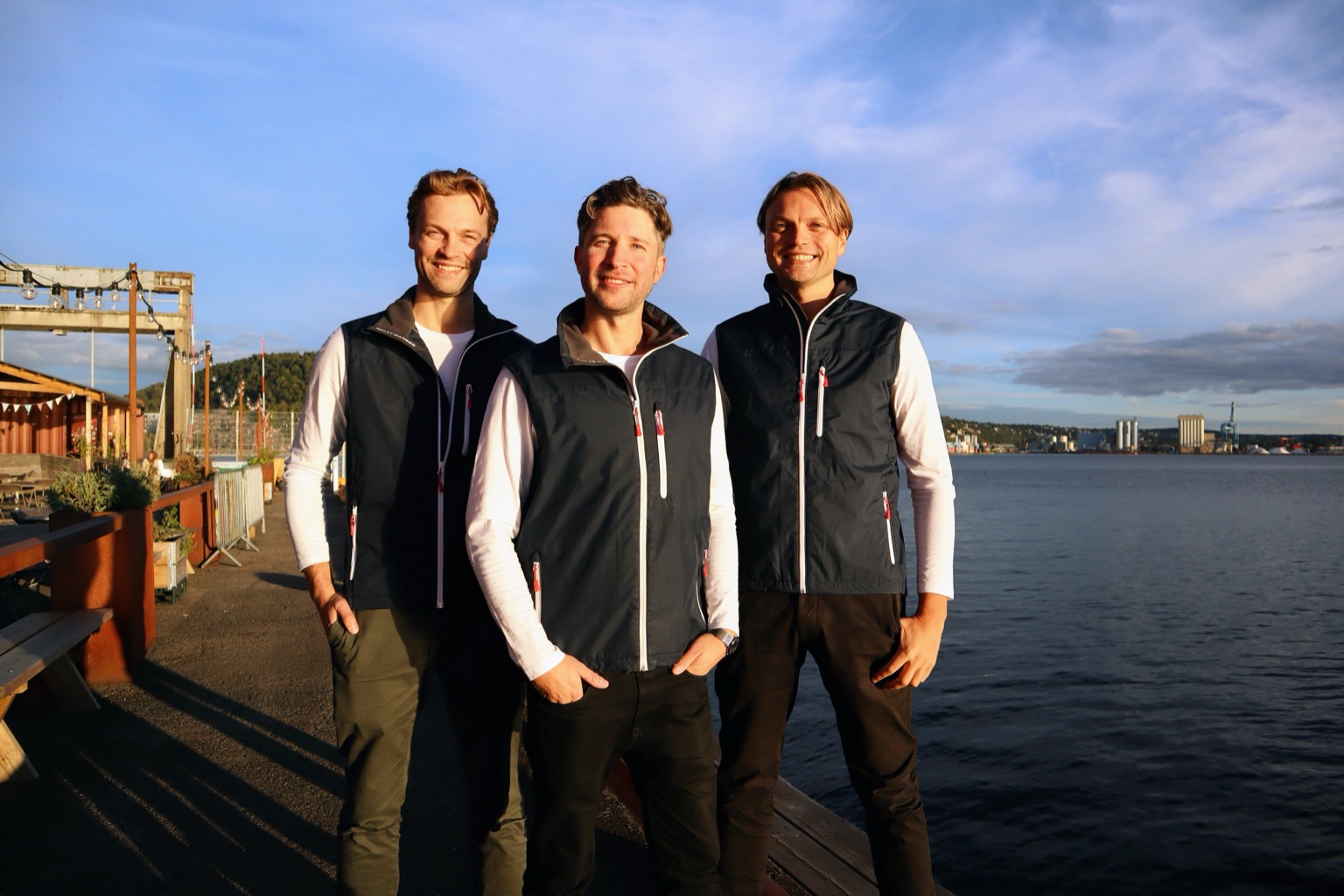
Simon, Adrian, and Are at Tjuvholmen
The word that keeps coming back
Six of the written reviews use "tailored" or "customised" (counted July 2026). Nobody was prompted to reach for it.
"Great experience, Simon shared his knowledge about Norway, lifestyle, tips for the city, etc. Highly recommend for small parties looking for a customized itinerary."
— Roberto Ferrero, Google, March 2025
"Simon was a great guide and captain. Very attentive to our needs and tailored the entire experience to make sure that we enjoyed every minute. Very professional attitude. Also very knowledgeable about the city, history and the landmarks."
— Amir U, TripAdvisor, August 2024
What the word points at is the absence of a fixed route. Before the trip the captain asks what interests you: swimming, history, photography, a birthday. The route is built around the answer, then adjusted on the water. A group deep in a conversation about Viking trade routes gets a longer conversation and a shorter swim stop. If the weather turns there is always a sheltered bay in the lee of Hovedøya, whichever direction the wind is coming from. A full account of what actually happens on one of these cruises reads more like a choose-your-own-adventure than an itinerary.
That only works because the boat is private and the group is small: seven guests at most, one captain, no other booking to hurry back for. We run several different tours, from three hours to a full day, and each one bends to the group.
Shown around by somebody who lives here
Thirty-four of the 68 written reviews name a captain. That is the clearest signal in the set. A guide recites facts. Someone who lives here tells you where they go on a day off, which island has the best swimming, why the lighthouse at Dyna is their favourite building in Oslo.
"Excellent afternoon sail with Simon and Adrian. We got to see Oslo from an entirely different perspective: not just 'from the water' instead of the land but from two smart guys who educated us on modern Norwegian life, history and culture."
— Peter Yeo, Google, March 2025
Peter Yeo arranged that trip the day before, through his hotel. The phrase he reaches for is "modern Norwegian life, history and culture", which is a fair description of where the conversation on the boat tends to go: architecture, politics, Viking trade routes, the housing market in Tjuvholmen, why Norwegians swim in October, where to find the best kanelbolle. I once spent twenty minutes explaining the Norwegian tax system to a couple from Texas because they kept asking. No script contains that.
It comes out of how the company is put together. Adrian and I co-founded it. Are joined because he wanted to share the fjord. All three of us live in Oslo, grew up on or near the water, and enjoy talking about the place. Guests hear the difference between enthusiasm that is real and enthusiasm that is performed, and it shows in the words they choose: "knowledgeable yet humble", "passionate", "wants everyone to have the experience they desire".
The comparison they reach for
Three reviews use the word "tourist", every time as something being escaped rather than joined.
"Simon took us for a tour of Oslo's waterfront and had great information about the city and history of the area. After, we boated around the islands and coastline to see some of his favorite places. A unique perspective of the area that's less touristy and very beautiful!"
— Corinne S, TripAdvisor, September 2024
Oslo has plenty of large boats with fixed routes, recorded commentary and dozens of passengers. They are fine, and one is much like another: same sights, same recording, same plastic seat. Guests describing Oslo Sea Experience keep framing it against that.
Part of it is the boat. The Cormate T28 is a Norwegian-built daycruiser rather than a tour vessel. It looks like something a local would own, because it is. Seven guests means the deck is yours. There is no welcome speech, no branded merch and no "and if you look to your left". You get a captain, a boat and the fjord.
Six reviews single out the sunset, which we understand. There is a spot behind Nakholmen where the light goes orange and pink at around 9:45pm in late June, and conversation stops. Nobody stages it. The light does what it does, and the boat is in the right place because the captain knows where to be and when.
What surprised us
The reviews are specific. Ten describe getting in the water, six describe the sunset, and thirty-four name the person driving the boat, which is why they read like recommendations from a friend rather than ratings.
Every review across the three platforms is five stars, which is statistically unusual. The live totals are on the platform pages linked at the top; the counts here were taken in July 2026 and the written ones in our register run from June 2024 to September 2025. The numbers matter less than what people actually wrote.
Why we think it works
We have no script and no system, but after reading all of them we have a theory. Any operator running fifty departures a week with rotating staff accumulates the occasional three- or four-star review: the weather was poor, the group too large, the pre-trip communication slow, the website photos promised a day the sky did not deliver. Those friction points are hard to design out at scale.
We are three people. Between us we answer the enquiries, plan the routes, prep the boat, drive it, serve the food, fly the drone and clean up afterwards. No operations team, no call centre, nobody between you and the person steering. Adrian once noticed a guest shivering ten minutes into a September trip and had a blanket out before she said anything. You catch that when you are standing right there.
"I can't recommend this enough! Simon is an amazing guide, knowledgeable yet humble. He captains the boat like he's never done anything else, and he genuinely wants everyone to have the experience they desire."
— Nomad01127888343, TripAdvisor, August 2024
That is the closest any of them come to a summary: three people who know the fjord, like people, and pay attention. We wrote this up because 79 reviews is a large enough sample to show patterns in what guests actually value on the water, which is rarely what the tourism industry assumes they value.
You can read the full collection of reviews on our testimonials page.
Review counts and word frequencies were taken from our own register in July 2026. Live totals sit on TripAdvisor, Google and GetYourGuide. Last reviewed: July 2026.
More from the fjord
What Actually Happens on a 3-Hour Oslo Fjord Cruise
From boarding at Tjuvholmen to swimming in hidden coves and cruising past forty islands. A private boat tour on the Oslofjord.
GuidePrivate Charter vs the Electric Sightseeing Cruise on the Oslofjord
The silent electric cruises (Brim, MS Brisen) are shared, scheduled and from ~690 kr a head. A private charter is the whole boat from 16,688. Which one fits your trip.
GuideTipping on an Oslofjord Boat Tour: A Guide for Visitors
Norway has no tipping culture in the American sense. On an Oslofjord cruise, NOK 200–500 is generous; a written review is more useful. What captains actually want.
See for yourself
Private Cormate T28 charter on the Oslo Fjord.
Up to seven guests. Fixed pricing. Departures from Tjuvholmen, Oslo.
Check pricing & availability