
Summer on the Oslofjord runs from mid-May to mid-September. Surface water reaches 17–19°C in June, peaks at 19–22°C in July and holds 18–21°C through August. At the solstice on 21 June 2026 the sun rises over Oslo at 03:53 and sets at 22:43, which is 18 hours and 50 minutes of daylight (sun times for Oslo, timeanddate.com). July is the warmest and busiest month, August holds nearly the same water with thinner crowds, and May and September are the quiet shoulder weeks.
Five months, and none of them behaves like the one before. What follows is what each does on the water, with the numbers that decide whether a day works: water temperature, daylight, and how many other boats you share the anchorage with. If you are weighing dates against a booking, the practical questions are answered here.
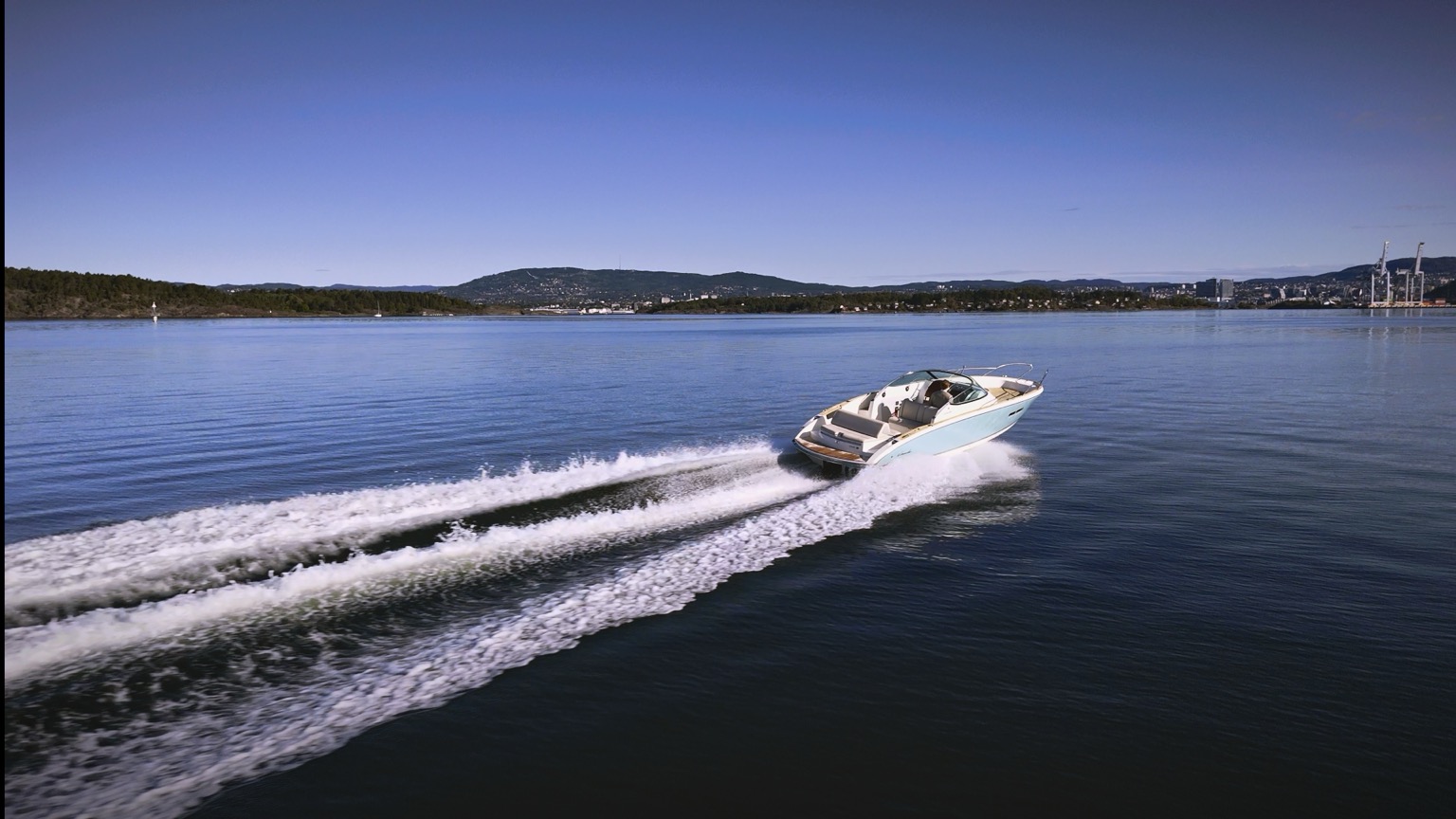
A summer day on the Oslofjord: clear skies, calm water, and light until close to eleven at night
May: 8–13°C
The water is cold. Surface temperatures sit at 8–10°C in early May and climb to around 13°C by the end of the month. The year-round swimmers are already in, but for most visitors this is not swimming weather.
Everything above the waterline is a different story. Daylight passes seventeen hours by late May, with the sun up until after 21:30. The islands are green and empty. Gressholmen (GRESS-hol-men), the nature reserve eighteen minutes out by ferry, has its wildflowers coming in. The first sailboats are back, white against a sky that has not warmed up yet. And the air holds a clarity you lose once the summer haze arrives in July.
Then there is 17 May, Norway's Constitution Day: children's parades, brass bands, families in bunad, ice cream queues down Karl Johan. The whole city is outside. From the water you get the harbour in one frame, flags along every quay, crowds on the piers, and the sound of marching bands carrying across the fjord. We have had guests tear up watching it from the boat, and Adrian pretends not to notice.
For time on the water, May gets the least credit of the five months. Conditions are usually calm, boat traffic is light, the light is sharp without midsummer haze, and the evenings already run long enough for a three- or four-hour cruise with room to spare before dark.
June: 17–19°C
On 21 June the sun rises at 03:53 and sets at 22:43. At 60°N it never drops far enough below the horizon for real darkness, so the eighteen hours and fifty minutes on paper understate what the night actually looks like: a luminous blue-white sky that Norwegians call hvite netter, the white nights. Times for any other date are in timeanddate's Oslo sun tables.
No table catches what that light does to the fjord. The water is still lit from the west at nine in the evening. An hour later it has gone amber, and by eleven it settles into a grey-gold that is neither day nor night. The golden hour here runs closer to ninety minutes, a slow descent that makes every surface worth framing.
Water temperatures reach 17–19°C by late June, and the swimming season starts properly in the sheltered bays between the islands, where the shallows warm faster than the open channel.
Two days after the solstice comes Sankt Hans, midsummer night, celebrated on 23 June. Bonfires go up along the shoreline and on the islands, and from a boat you see them on Hovedøya, on Langøyene (LANG-oy-en-eh), on headlands up and down the fjord. Most people bring something to grill. Nobody is in a hurry.
By late June every island ferry route is running, the Cistercian ruins on Hovedøya are open to walk through, and the café on Gressholmen is serving.
July: 19–22°C
Daytime highs sit at 22–25°C, and heatwaves push above 30°C. The water follows: 19–22°C at the surface, with the shallow bays around Langøyene touching 23–24°C, warm enough that you forget which latitude you are at.
The islands are full. Langøyene is the only inner-fjord island where camping is allowed, and in July it has families spread across the grass with tents and barbecues. Swimmers line the rocks, kayakers thread between anchored sailboats, and on warm weekends the 10:00 ferry to Hovedøya is standing room only.
July is when Oslo empties and refills. Norwegians leave for cabins or fly south, and in their place come international visitors, cruise passengers on day stops, and Scandinavians from Copenhagen and Stockholm who worked out some time ago that Oslo in July is a warm-weather city.
Along the waterfront, Aker Brygge and Tjuvholmen (TYUV-hol-men) run at full volume. Terraces face the harbour, grilled seafood competes with sunscreen and salt water, and children jump off the floating saunas at Sørenga. People land at Gardermoen expecting grey skies and wool sweaters and find locals in swimsuits eating ice cream on the docks at ten in the evening.
There is room for all of it in a single day: a morning swim, an island after lunch, dinner at anchor in a quiet bay while the sun works its way west. A full-day tour covers that without rushing, and the light allows it, with sunset around 22:40 at the start of July and 21:50 by the end.
August: 18–21°C
If we had to pick one month for a first-time visitor, it would be August.
The water is still 18–21°C and the weather is often as good as July's, but the light has started to move. Sunset falls around 21:46 on 1 August and pulls back to around 20:25 by the end of the month, and the lower sun angle brings the golden hour earlier and burns it harder. The fjord takes colours in the evening that July never gets to.
This is when sunset cruises are at their best: long light, water still warm enough to swim mid-trip, and anchorages that feel private again now that the crowds have thinned.
Hovedøya in mid-August is a different island from Hovedøya in mid-July. The ruins and the pine paths are the same, but there is room to sit on a rock by the shore and hear nothing except water against stone.
September: 15–17°C
The water has cooled to 15–17°C by September: comfortable for confident swimmers, bracing but swimmable for everyone else.
The bigger change is colour. Birch and aspen on the islands begin to turn, yellow first, then amber and rust, and against the dark green of the pines and the blue of the water the effect is quieter than a New England autumn and holds its own. Daylight is down to about thirteen hours by mid-September, and the sun sits low enough that even midday has a warmth of tone rather than temperature.
Sunset comes at 19:30 by mid-September and earlier still by the equinox, so evening cruises start in afternoon light and finish as the sky goes deep blue. The ferries run less often, the islands are nearly empty, and the fjord goes quiet in a way that feels like having a national park to yourself fifteen minutes from a capital city.
What to do on the water
Swimming
The Oslofjord swimming season runs from mid-June into early September for most people, though locals will tell you it opens in May and does not close until October. The right spot depends on what you are after: Langøyene for sandy shallows and families, Hovedøya for rocky coves with clear water, Sørenga for an urban swim with the Opera House behind you. The inner fjord was heavily polluted in the mid-20th century and the reputation outlived the pollution. The municipality measures temperature and water quality at the bathing spots through the summer and publishes a reading for each one, so check the Oslo municipality bathing-water page before you get in.
Island hopping
The inner-fjord islands are served by Ruter public ferries from Aker Brygge, and a regular transit ticket covers the crossing. Hovedøya is seven minutes out, which is the part visitors refuse to believe until they are standing on it looking back at the skyline through pine trees. The circuit takes in Hovedøya (monastery ruins, swimming, walking trails), Gressholmen (nature reserve, café), Langøyene (camping, swimming), and Bleikøya (BLAY-koy-ah) and Nakholmen (NAHK-hol-men) with their quiet cabin communities. By private boat you can carry on to the outer islands like Steilene (STAY-leh-neh) and the skerries south of Nesodden.
Kayaking
The water around Bjørvika and out toward the inner islands is calm enough for beginners on most summer days, and several rental outfits work from the harbour area. Experienced paddlers go further: behind Hovedøya, along the Nesodden shoreline, or out to Steilene on settled days. What a kayak gives you is silence. You sit at water level, close enough to see jellyfish drifting below and to hear water lapping against rock.
Fishing
The Oslofjord holds mackerel, sea trout and other species. Mackerel arrive in numbers from late June and stay through August, and you can catch them on a handline from almost any boat; sea trout ask for more patience and local knowledge. Cod are off-limits. Targeted cod fishing is banned throughout the Oslofjord and every cod caught has to be released, under the fishing regulation for the Oslofjord in force since 1 January 2026. No licence is needed for recreational saltwater fishing in Norway, but the fjord rules are stricter than the national baseline on gear, closed zones and seasons, so read the regulation before you fish.
Sunset watching
The Oslofjord sunset has an article of its own. High latitude, low sun angle and reflective water combine into a golden hour that runs ninety minutes or more. From June through August the sun sets in the northwest, so west-facing anchorages between the islands get the whole show. In September it sets earlier and further south, and the lower angle with drier air still produces evenings that match midsummer.
Before you go
Dress in layers. Even in July, with 25°C on shore, wind on the water takes 5–8 degrees off the felt temperature, so a light windproof jacket earns its space even if you leave the marina in a t-shirt. Add a fleece in May and September. Wear shoes with grip, because a boat deck is no place for leather soles. Bring a hat: the sun at 60°N sits lower in the sky than you expect and hits your face directly for long stretches.
The UV index in Oslo peaks at 6–7 in June and July, which is moderate by Mediterranean standards and misleading. Long daylight hours make cumulative exposure high, and reflection off the water adds another 10–25%. Factor 30 is the floor, reapplied after swimming.
Getting to the water takes no planning. Oslo's waterfront is walkable from the centre, the Ruter ferry terminal at Aker Brygge serves the inner-fjord islands, and private boat tours leave from Tjuvholmen marina five minutes along the quay. A continuous promenade connects the whole harbour from Sørenga in the east to Tjuvholmen in the west.
For weather, use yr.no from the Norwegian Meteorological Institute, which is what locals use. Summer rain in Oslo arrives as short showers rather than all-day grey, and an afternoon downpour often clears into a fine evening. Wind matters more than rain out here, so read the wind forecast as closely as the temperature.
Budget for a city that is expensive by most standards. A meal at a waterfront restaurant runs 250–500 NOK per person and museum entry is typically 100–180 NOK. The ferry to the islands costs the same as any transit ride, around 46 NOK for a single as of July 2026 (current Ruter fares), less with a day pass. Swimming, walking the islands and watching the sun go down cost nothing.
Picking a month
Water temperature moves ten degrees across the five months, daylight swings from seventeen hours to thirteen, and the islands go from empty to full to empty again. Pick the week to match what you want out of it.
If you only get here once, make it August. A second trip belongs in late May, before the crowds. Either way, check VisitOslo's event calendar first, so you do not book a hotel into a sold-out concert weekend.
By July the inner fjord settles into something predictable: glassy mornings, a light afternoon breeze from the south, water at 19 or 20 degrees. Most of our regulars come between 20 June and 15 August. At 22:00 the light still reads as 18:00, so guests want to keep going past sunset.
Sea temperatures, ferry fares and event dates move from year to year, and the monthly figures here are typical ranges rather than fixed values. Check the live Oslofjord sea temperatures, current Ruter fares and the yr.no forecast before you plan. Last reviewed: July 2026.
More from the fjord
Oslo in Summer: What the Locals Actually Do
Island ferries for 42 kroner, 23°C swimming coves, floating saunas and 18-hour days: how Oslo actually spends its summer, month by month.
GuideOslo in Winter: What's Open, What's Worth It, and How Dark It Really Gets
Around six hours of daylight, sledding from the metro, free skating at Spikersuppa and the exact days Oslo closes for Christmas. November to March, honestly.
GuideRain on the Oslofjord: Will the Cruise Still Run?
Rain alone does not stop an Oslofjord cruise. Wind, swell, and lightning do. The weather criteria, when we reschedule, and how the boat handles a wet day.
See for yourself
Private Cormate T28 charter on the Oslo Fjord.
Up to seven guests. Fixed pricing. Departures from Tjuvholmen, Oslo.
Check pricing & availability