Every big list of things to do in Oslo gives the fjord a line or two, somewhere below the shopping street and next to a viewpoint. The water fills the southern half of the city's horizon, and it holds enough swimming, islands, saunas, seals and war history to occupy a full week.
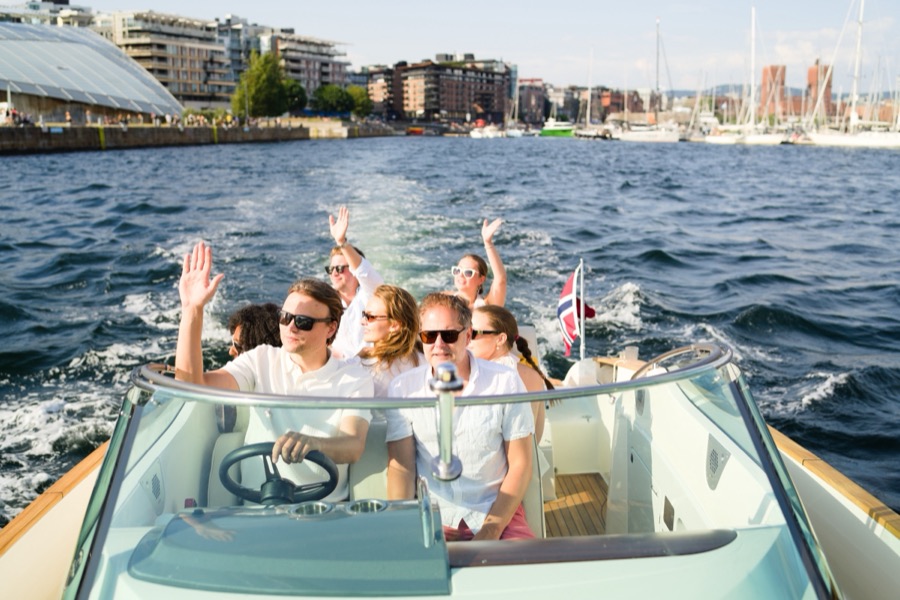
We run a boat out of Tjuvholmen daily through the season, which makes us biased and, more usefully, specific. What follows is the fjord's own list: nine things to do on the Oslofjord, each with the cheap way to do it (usually a Ruter ferry) and the private-boat way. Every one of them has a full article of its own on this blog, and this page is the map.
Most of it starts within ten minutes of the City Hall.
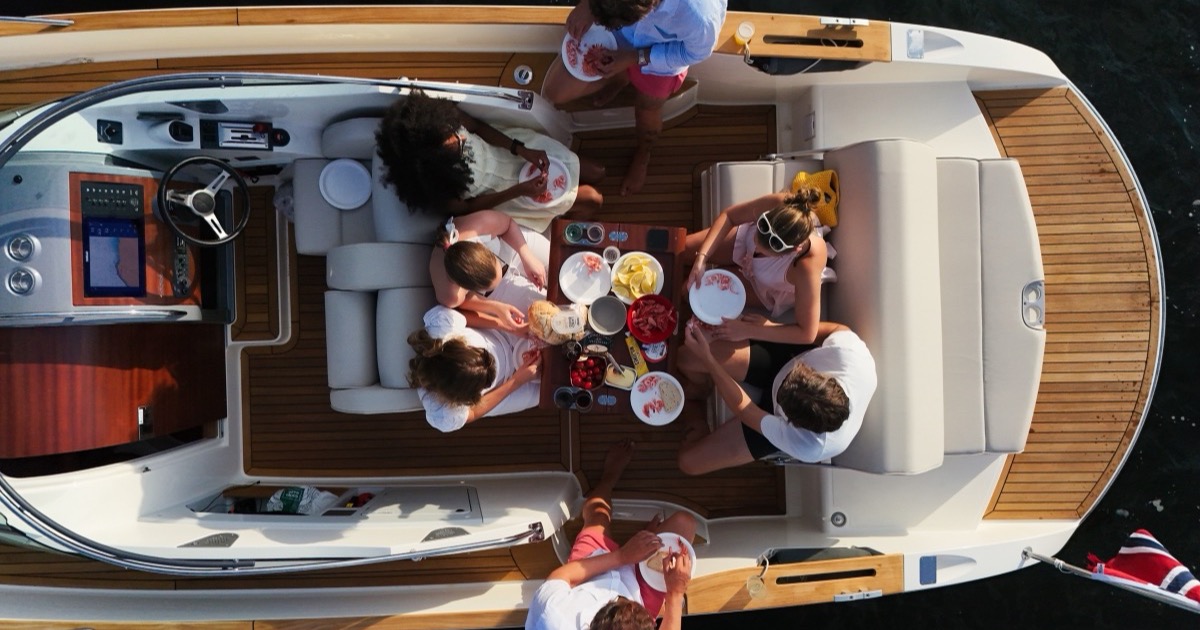
The inner Oslofjord: islands, ferries and open water, minutes from the City Hall
Island hopping on an ordinary transit ticket
The islands closest to the city are served by public ferry from Rådhusbrygga: line B1 to Bleikøya, Gressholmen, Lindøya and Nakholmen year-round, B1X to Hovedøya and B2 to Langøyene in summer. A standard zone 1 Ruter ticket covers all of them, around 46 NOK single and 137 NOK for 24 hours (per July 2026; check current fares at ruter.no), the same ticket that runs the metro. Ruter expands the boat service from 16 May through August (see the current boat timetables at ruter.no).
Hovedøya, the closest island, has the ruins of a Cistercian monastery founded in 1147 (Store norske leksikon) and two beaches on its western side; osloislands.com keeps ferry times and practical notes for Hovedøya. Langøyene, about 25 minutes out, has the sandy beach, the volleyball courts and free tent camping in a marked area for up to two nights. Our ferry island-hopping guide covers routes and timing, and the island guide ranks them by what you want from the day.
A swim in the middle of a capital
The harbour cleanup made the inner fjord officially swimmable, and Oslo Kommune measures bathing temperature and water quality from June to August. Sørenga sjøbad is an open-air seawater pool a short walk from the Opera House, and Huk on Bygdøy is the classic sandy beach. Tjuvholmen has two bathing spots beside the galleries, right next to our departure dock, so we watch the morning swimmers all summer. The water peaks at 18–22°C from mid-July to mid-August and sits around 14–17°C in June. One local rule worth copying: skip the swim for a day after heavy rain, when overflow can drag the water quality down.
Where and when is covered in the swimming guide, the coves you will not find on foot are in secret beaches, and how the water got clean again is the subject of the harbour cleanup piece.
Floating saunas, twelve months a year
Three sauna operators sit on the water in central Oslo, and all three share the same quay at Langkaia between the Opera House and Akershus Fortress: KOK, SALT and the non-profit Oslo Badstuforening. Badstuforeningen's Langkaia site alone is a village of six floating saunas, the biggest taking 18 people, and a shared session there costs NOK 150 for members and NOK 260 for everyone else (July 2026). The stove runs hot while the fjord outside sits at 2–4°C in January, which is the whole point of the exercise. KOK also runs rafts with silent electric outboards, so the sauna doubles as the fjord tour.
This is the one fjord activity with no season at all. The full rundown is in our floating saunas guide.
Fishing, with the 2026 rules attached
Cod fishing is banned outright in the whole Oslofjord, year-round. From 1 January 2026, three large zones (one in the inner fjord, two around Færder and Ytre Hvaler national parks) are closed to all fishing of any kind, under a regulation that runs to 31 December 2035. Outside those zones you may fish with hand-held gear only: a rod, a hand line, something you physically hold. No licence is needed for saltwater fishing in Norway.
What still delivers is mackerel, which arrives in schools from mid-June and stays through September. The rules, the zone boundaries and the reasons the cod are gone are laid out in the fishing guide and the cod crisis piece.
Kayaking before the wind wakes up
The inner harbour basin is sheltered enough for beginners in almost any conditions. The trick is timing: the fjord channels the southwesterly up its length, and on a summer afternoon that builds into a steady 10–15 knots. Morning paddlers get flat water and an easy run home, and the crossing to Hovedøya is straightforward on a calm day. Routes and rental spots are in the kayaking guide.
Porpoises, seals and a pair of sea eagles
The inner fjord has harbour porpoises all year. Nobody has counted them here, but from our own seasons on the water we put it at 70 to 80 animals (more in our wildlife guide), and the deeper channels east of Nesodden are where we meet them most often. Harbour seals turn up on the rocks at Steilene now and then, single animals wandering in from the outer-fjord haul-outs: grey-brown lumps that occasionally lift a head to watch the boat pass. Mid-August through September is moulting season, when seals spend the most time ashore and your odds are best. White-tailed eagles nest on Håøya, where a chick fledged in the summer of 2008, the first successful breeding at the Oslofjord in 126 years.
Steilene has no ferry. There are two ways in: a private boat, or a long kayak run in experienced hands. More in the porpoise article and the Steilene seals piece.
The war story in the narrows
The Oslofjord runs about 100 kilometres from Færder to the city, and at Drøbak it squeezes to roughly one kilometre wide. In that narrow sound, early on the morning of 9 April 1940, the guns of Oscarsborg fortress opened fire on the German heavy cruiser Blücher. The main battery held three 28-centimetre Krupp guns from the 1890s, named Moses, Aron and Josva; Josva stood unmanned that night. Moses and Aron each fired a 255-kilo shell, and a pair of 40-year-old torpedoes finished the job, sinking one of Germany's newest warships at close range (Battle of Drøbak Sound). Colonel Birger Eriksen, questioned on his own order, answered: "Either I will be decorated or I will be court-martialled. Fire!" The delay let King Haakon VII, the government, the parliament and the gold reserve get out of Oslo.
Oscarsborg is a museum today, five minutes by boat from Drøbak harbour. The full story is in the Blücher article, and the logistics in the Drøbak and Oscarsborg day trip guide.
Eating with your feet over the water
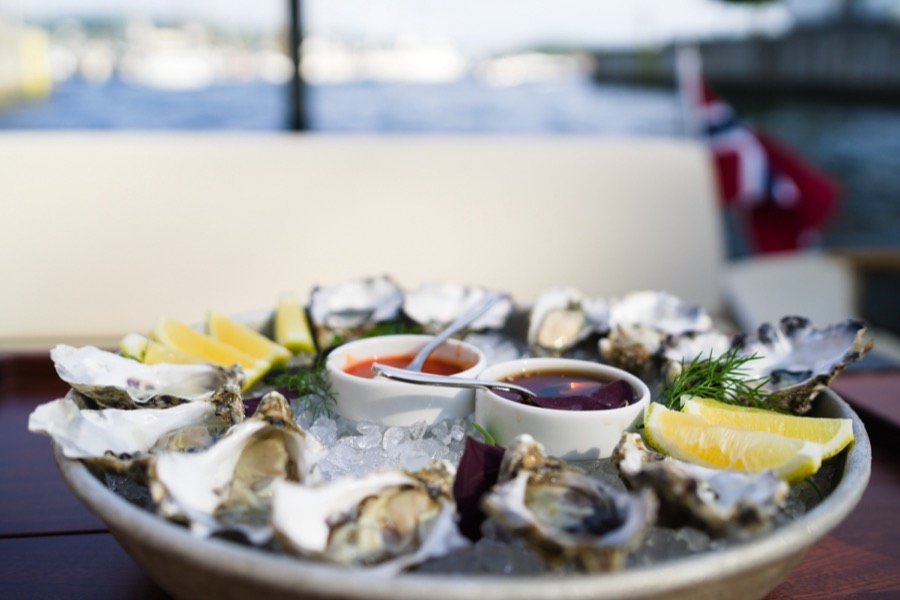
By our own count, at least 15 waterfront restaurants on the fjord keep a guest pier where a boat can tie up for lunch. Lille Herbern occupies its own islet off Bygdøy, with a small ferry of its own and a terrace facing the sea. Gressholmen Kro serves seafood on the island where Oslo's first airport took seaplanes from 1927 until the seaplane harbour moved to Fornebu in 1952 (Wikipedia). On our own tours the food comes aboard instead: we work with Oslo restaurants and serve on the boat, so the meal and the view travel together.
Every pier and cluster, from Aker Brygge to Drøbak harbour, is in the dock and dine guide.
Long midsummer twilight
In mid-June the sun goes down at 22:44 in Oslo and the sky still holds usable light at 00:22 (sunrise-sunset.org, checked July 2026). This far north the sun sets at a shallow angle, so the light slides through gold and rose for well over an hour instead of dropping. That geometry is why our sunset cruise lasts four hours (20,048 NOK including VAT for the whole boat, up to seven guests) rather than a quick out-and-back. Best months and where the light does its work are in the sunset guide.
Guests ask when the sunset is, and in June the honest answer is: for about two hours. The sun touches the horizon a quarter to eleven and the colour keeps working long after. Four hours on the water is what that light actually takes.
Doing the Oslofjord free, or by boat
Both are legitimate, and they solve different days. The free version rests on two public goods: the ferry network on a zone 1 ticket, and allemannsretten, the Norwegian right of public access that lets you swim, land and walk the shore without paying anyone. That combination covers the inner islands, most of the bathing, the saunas at drop-in rates and the shore fishing.
The boat version buys reach and control. A private cruise runs from 16,688 NOK including VAT for three hours, whole boat, up to seven guests, and a full-day charter reaches the outer islands the ferries never touch, Steilene and its seals included. You choose the route, the anchor spots and the pace. The tour overview lists what each format does, and booking takes about two minutes.
If your party is larger than seven, ask us. We will look into a second boat for that day and answer yes or no, which is the arrangement behind a bachelor or bachelorette party and a company event.
When to do what on the Oslofjord
Swimming peaks from mid-July to mid-August. The light is longest and the sunsets latest in June. Mackerel run from mid-June through September, the seals show best from mid-August through September, and the saunas carry the winter. If your dates are already fixed, the month-by-month guide tells you what the fjord is doing that week, and what is the Oslofjord explains the geography underneath all of it.
The B1 leaves Rådhusbrygga right through the summer season. Start there.
Fares, timetables, sauna prices and fishing zones change through the year; the linked pages are the live versions. Last reviewed: July 2026.
More from the fjord
Getting Married at Oslo City Hall, and the Afternoon After
Oslo City Hall marries couples on Wednesdays, Fridays and Saturdays in front of a Munch painting, 30 guests maximum. The paperwork, the costs, and the fjord after.
GuideViking Ship Museum in Oslo: Closed Until 2027, and What to See Instead
The Viking Ship Museum on Bygdøy is closed until November 2027. Where the Oseberg, Gokstad and Tune ships are now, and what to see in Oslo in the meantime.
GuideOslo in Summer: What the Locals Actually Do
Island ferries for 42 kroner, 23°C swimming coves, floating saunas and 18-hour days: how Oslo actually spends its summer, month by month.